| - | - | - |
|---|---|---|
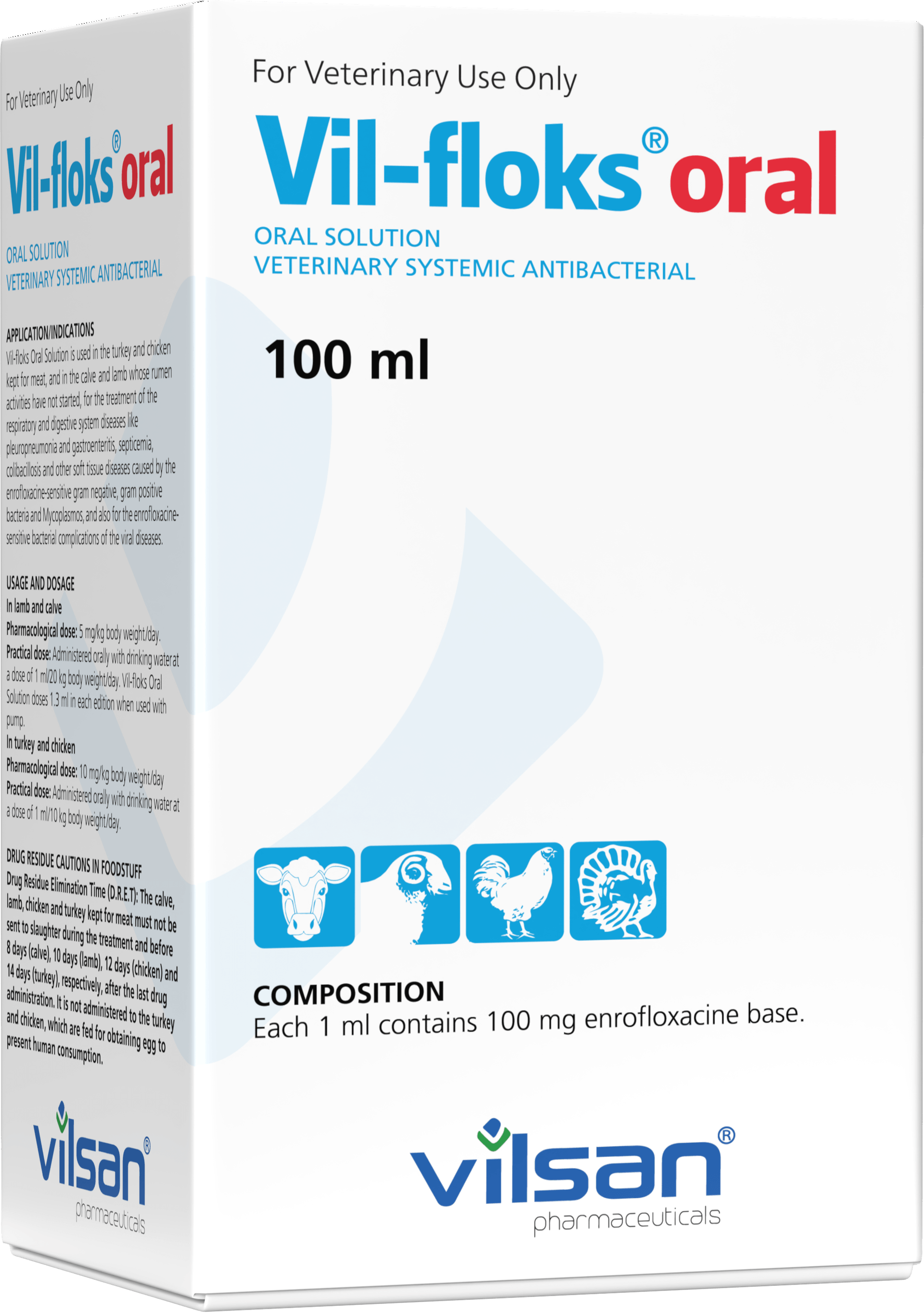
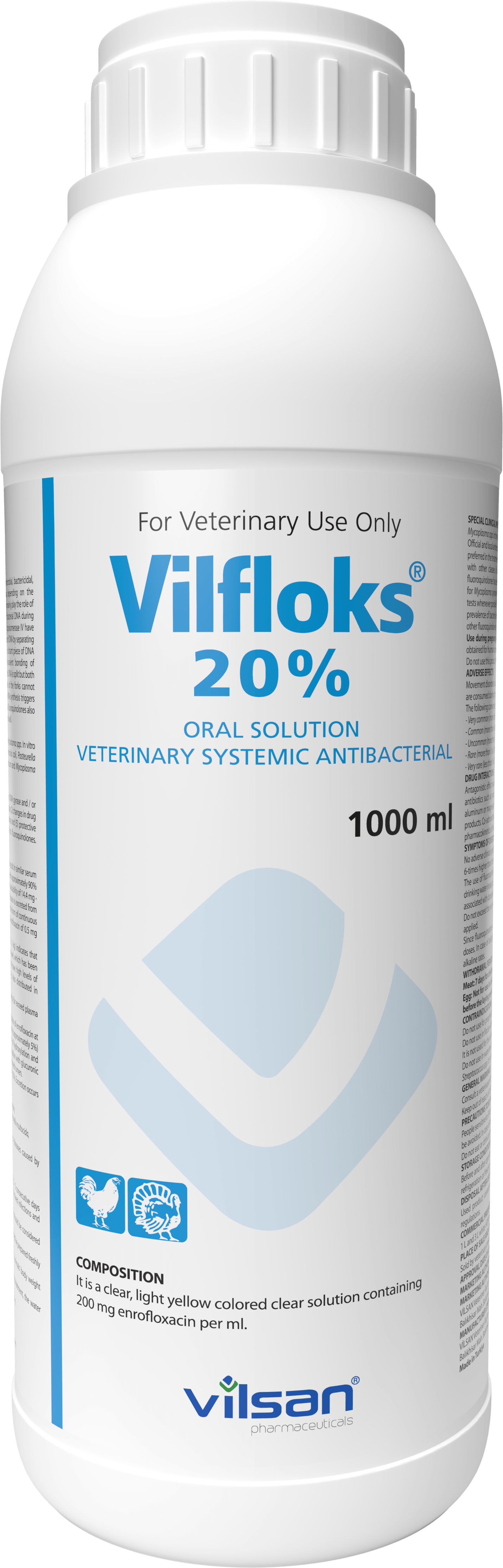
| Product Group | : | Antibacterials |
| Pharmaceutical Form | : | Oral Solution |
| Active Ingredient | : | Enrofloxacin |
| Target Animal | : | Chicken, Turkey, Rabbit |
| Package Form | : | 1L and 3 L white HDPE drums |
COMPOSITION
It is a clear, light yellow colored clear solution containing 200 mg enrofloxacin per ml.
PHARMACOLOGICAL PROPERTIES
Pharmacodynamic Properties
Mechanism of Action
Enrofloxacin is a synthetic, third generation fluoroquinolone group, broad spectrum antimicrobial, bactericidal, effective against many gram-positive and gram-negative bacteria and mycoplasmas, depending on the concentration. Among antimicrobials, the mechanism of action of quinolones is special; They mainly play the role of inhibiting bacterial DNA gyrase, an enzyme responsible for controlling the supercoiling of bacterial DNA during replication. Two enzymes essential in DNA replication and transcription; DNA gyrase and topoisomerase IV have been identified as the molecular target of fluoroquinolones. It alleviates the topological state of DNA by separating and resealing (closing) reactions. Initially, both strands of the DNA double helix split. Then a distant piece of DNA passes through this without the strands being resealed. Target inhibition; The non-covalent bonding of fluoroquinolone molecules causes an intermediate stage of these sequential reactions in which DNA is split but both strands remain covalently bound to enzymes. The replication and translational complexes of the forks cannot continue beyond such enzyme-DNA-fluoroquinolone complexes. Inhibition of DNA and mRNA synthesis triggers events that result in the rapid, drug concentration-dependent killing of pathogenic bacteria. Fluoroquinolones also act against bacteria in stationary phase by changing the permeability of the phospholipid cell wall.
Antibacterial Spectrum
Enrofloxacin is effective against many gram negative bacteria, gram positive bacteria and Mycoplasma spp. In vitro susceptibility was observed in strains of gram-negative bacterial species such as Escherichia coli, Pasteurella multocida and Avibacterium (Haemophilus) paragallinarum, as well as Mycoplasma gallisepticum and Mycoplasma synoviae.
Type and Mechanism of the Resistance
Resistance to fluoroquinolones has been reported from five sources; (1) In genes coding for DNA gyrase and / or topoisomerase IV, the formation of changes in the relevant enzyme as a result of point mutation, (2) changes in drug permeability in gram-negative bacteria, (3) eflux mechanisms, (4) plasmid mediated resistance and (5) protective proteins from gyrase. All these mechanisms cause reduced susceptibility in bacteria to fluoroquinolones. Cross-resistance is common amongst the fluoroquinolone group of antimicrobials.
Pharmacokinetic Properties
The pharmacokinetics of enrofloxacin are such that; Both oral and parenteral administration result in similar serum levels. Enrofloxacin applied to poultry with drinking water is rapidly and very well absorbed with approximately 90% bioavailability. A maximum plasma concentration of 2 mg/L is reached with a total systemic availability of 14.4 mg · hour / L within 1.5 hours after 10 mg/kg body weight single oral dose administration. Enrofloxacin is excreted from the body with a total body clearance of 10.3 ml / minute · kg. If the dose is administered in the form of continuous spraying of drinking water (multiple dose administration); Steady-state concentrations of enrofloxacin of 0.5 mg (turkey) to 0.8 mg (chicken) per liter are reached.
Enrofloxacin has a high volume of distribution. A high mean volume of distribution (5 L / kg) indicates that enrofloxacin penetrates well into tissues. Tissue levels are 2 - 3 times higher than serum level, which has been demonstrated in laboratory animals and target species. The organs that are expected to have high levels of concentrations are lungs, liver, kidney, skin, bone and lymphatic system. Enrofloxacin is also distributed in cerebrospinal fluid, chamber fluid and fetuses in pregnant animals.
Concentrations in target tissues such as lung, liver, kidney, small intestine and muscle tissue by far exceed plasma concentrations.
The degree of metabolism depends on the species and ranges from 50 to 60%. Biotransformation of enrofloxacin at the hepatic level results in its active metabolite ciprofloxacin. In poultry, enrofloxacin is poorly (approximately 5%) metabolised to its active metabolite, ciprofloxacin. Generally, metabolism takes the form of hydroxylation and oxidation to oxofluoroquinolones. Other reactions that occur are N-dealkylation and conjugation with glucuronic acid. Bioavailability of enrofloxacin is 80% in monogastric mammals and calves with undeveloped rumen.
Enrofloxacin is excreted with a half-life of 6 hours. Protein binding in poultry is approximately 25%. Excretion occurs mostly in urine, renal tract and bile.
AREA OF USE/INDICATIONS
Used for the treatment of infections caused by the following bacteria susceptible to enrofloxacin;
Chicken: Mycoplasma gallisepticum, Mycoplasma synoviae, Avibacterium paragallinarum, Pasteurella multocida,
Turkey: Mycoplasma gallisepticum, Mycoplasma synoviae, Pasteurella multocida.
Rabbit: For the treatment of bacterial enteritis caused by E.coli infection and infectious diseases caused by Pasteurella multocida
USAGE AND DOSAGE
Chicken and Turkey
It is mixed with drinking water at a daily dose of 10 mg / kg body weight and given for 3 - 5 consecutive days depending on the severity of the infection. It should be applied for 5 consecutive days in mixed infections and chronic progressive forms.
If no clinical improvement is achieved within 2 - 3 days, alternative antimicrobial therapy should be considered according to the result of the sensitivity test.
It should always be made sure that the entire dose given is consumed. Medicated water should be prepared freshly every day and just before it is given to animals.
Animals should not be allowed to drink from another water source during the treatment. Animals' body weight should be calculated as accurately as possible to avoid low doses.
Pumping systems must be constantly checked to ensure proper spraying. Before starting treatment, the water system should be emptied and filled with medicated water.
The daily amount of required product (ml) during the treatment period is calculated as follows:
Total poultry animal count × Average body weight (kg) × 0.05 ml = Daily total volume (ml)
Rabbit
10 mg/kg body weight, 5 consecutive days.
The daily amount of required product (ml) during the treatment period is calculated as follows:
Total rabbit count × Average body weight (kg) × 0.05 ml = Daily total volume (ml)
SPECIAL CLINICAL INFORMATION AND SPECIAL WARNINGS FOR TARGET SPECIES
Mycoplasma spp. In the treatment of infections, the infection may not be completely eradicated.
Official and local antimicrobial policies should be considered when using the product. Fluoroquinolones should be preferred in the treatment of clinical conditions that respond poorly or are expected to respond poorly to treatment with other classes of antibiotics. Since the first use of enrofloxacin in chickens, E.coli's susceptibility to fluoroquinolones has decreased widely and resistant organisms have emerged. Resistance has also been reported for Mycoplasma synoviae in Europe. Fluoroquinolones should only be used based on the results of susceptibility tests whenever possible. The instructions for use given in the package insert should be followed, if not followed, the prevalence of bacterial resistance against fluoroquinolones may increase and the effectiveness of treatment with other fluoroquinolones may decrease due to potential cross resistance.
Use during pregnancy, lactation and laying: It should not be used in chickens and turkeys whose eggs are obtained for human consumption.
Do not use this product 14 days before the beginning of the laying period in pullets.
ADVERSE EFFECTS
Movement disorders caused by damage to the joint cartilage can be seen when large amounts of medicated water are consumed during the growing period, especially in high temperatures.
The following conversion is used in reporting the frequency of side effects;
- Very common (more than 1 in 10 animals)
- Common (more than 1 but less than 10 in 100 animals)
- Uncommon (more than 1 in 1,000 animals but less than 10)
- Rare (more than 1 in 10,000 animals but less than 10)
- Very rare (less than 1 in 10,000 animals)
DRUG INTERACTIONS
Antagonistic effect was observed in in vitro medium when Fluoroquinolones used together with bacteriostatic antibiotics such as macrolide, tetracycline and phenicols. Simultaneous administration with agents containing aluminum or magnesium may reduce the absorption of enrofloxacin. Do not use with steroid anti-inflammatory products. Co-administration of enrofloxacin with other drugs known to be metabolized in the liver may affect the pharmacokinetics of these drugs.
SYMPTOMS OF OVERDOSE, PRECAUTIONS AND ANTIDOTE
No adverse clinical symptoms were observed in chickens and turkeys, respectively, when doses up to 10-times and 6-times higher than the treatment dose were administered.
The use of fluoroquinolone during the growth phase is associated with a significant and prolonged increase in drinking water intake, possibly due to high temperature, and thus an increase in active ingredient intake, potentially associated with damage to articular cartilage.
Do not exceed the recommended dose. There is no antidote for accidental overdose and symptomatic treatment is applied.
Since fluoroquinolones are mainly excreted by the kidneys, they may damage the kidneys when given in high doses. In case of taking excessive amounts of medication, they should drink plenty of water and increase urine alkaline rates.
WITHDRAWAL PERIODS
Meat: 7 days for chicken, 13 days for turkey and 3 days for rabbit.
Egg: Not for use in chickens and turkeys used for human consumption. Not for use in laying hens 14 days before the laying period.
CONTRAINDICATIONS
Do not use for prophylactic purposes.
Do not use in flocks with resistance / cross resistance to (Fluoro) quinolones.
It is not used for the animals known to be sensitive to active substance, other (fluoro)quinolons or excipients.
Do not use in waterfowl.
Streptococcus spp. It is not used due to severe resistance in infections.
GENERAL WARNINGS
Consult a veterinarian before use and if any unexpected reactions occur.
Keep out of reach of children and away from foodstuffs.
PRECAUTIONS TO BE TAKEN BY THE ADMINISTRATOR AND WARNINGS FOR VETERINARY SURGEON
People sensitive to (Fluoro) quinolones should avoid to contact with the product. Contact with eyes and skin should be avoided. In case of splashes to eyes or skin, it should be rinsed immediately with water.
Do not eat or drink anything, including cigarettes, during the application. Wash hands after use.
STORAGE CONDITIONS AND SHELF LIFE
Before and after opening, it should be stored in the original packaging, protected from light, below 25°C, without refrigeration or freezing. Shelf life is 2 years.
DISPOSAL AFTER USE AND WARNINGS FOR NON-TARGET SPECIES
Used product containers and any unused or leftover product must be disposed of according to applicable regulations.
COMMERCIAL PRESENTATION FORM
1 L and 3 L white HDPE plastic bottles with boxes.
PLACE OF SALE AND CONDITIONS
Sold by veterinary prescription in pharmacies and veterinary clinics (VSP).
APPROVAL DATE OF LEAFET: 28.07.2025
MARKETING AUTHORIZATION DATE AND NO: 09.11.2006 – 017/0011
MARKETING AUTHORIZATION HOLDER
VİLSAN Veteriner İlaçları Tic. ve San. A.Ş.
Balıkhisar Mah. Balıkhisar Köy İçi Küme Evleri No:765A Akyurt/Ankara–Türkiye
MANUFACTURER COMPANY
VİLSAN Veteriner İlaçları Tic. ve San. A.Ş.
Balıkhisar Mah. Balıkhisar Köy İçi Küme Evleri No:765A Akyurt/Ankara–Türkiye
Made in Turkiye