| - | - | - |
|---|---|---|
| Product Group | : | Antibacterials |
| Pharmaceutical Form | : | Solution for Injection |
| Active Ingredient | : | Florfenicol |
| Target Animal | : | Cattle, Sheep |
| Package Form | : | In 50 ml, 100 ml and 250 ml colorless vials |
COMPOSITION
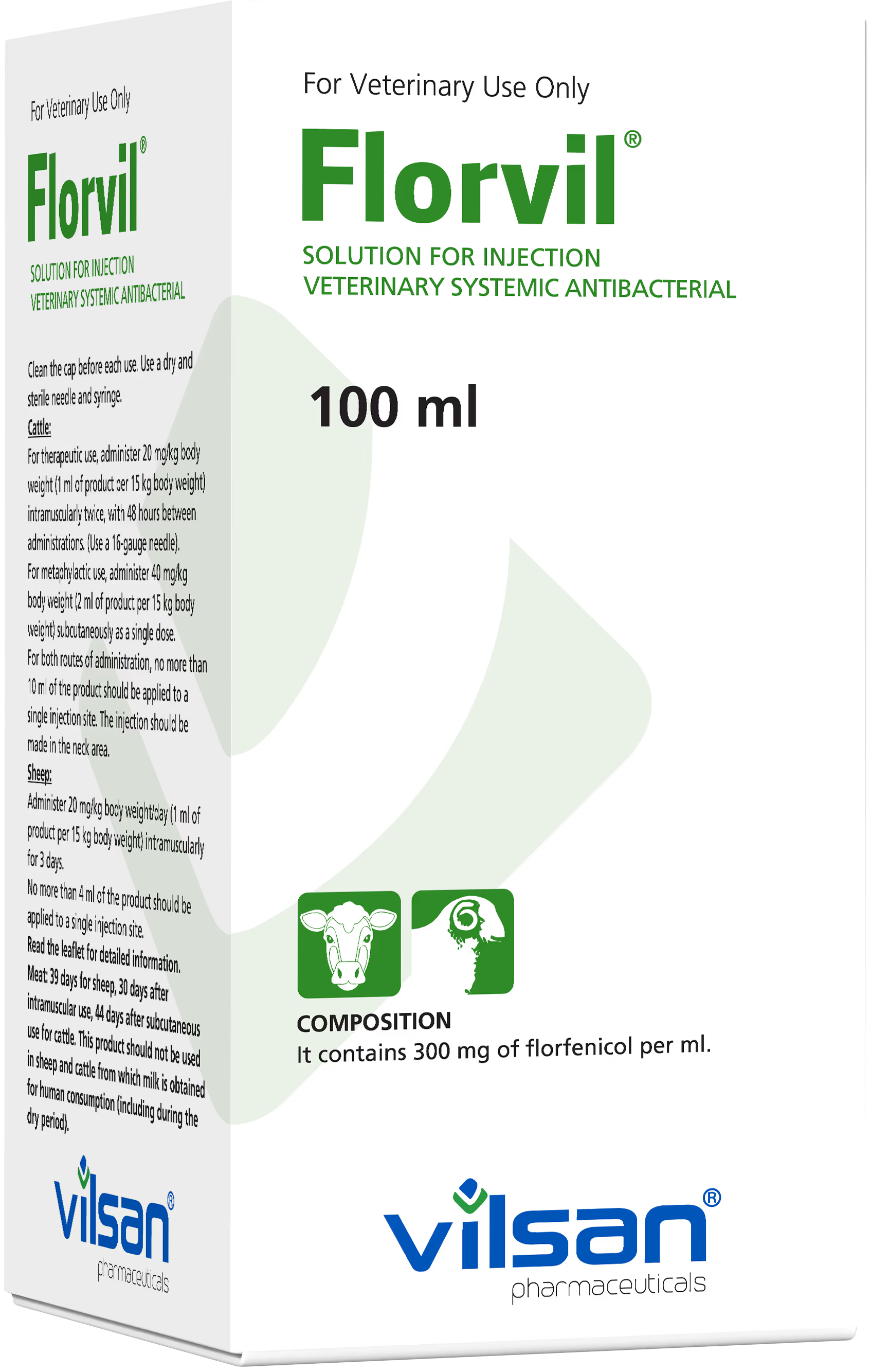
Florvil is a clear, yellowish, slightly viscous sterile solution containing 300 mg of florfenicol per ml.
PHARMACOLOGICAL PROPERTIES
Pharmacodynamic Properties
Florfenicol is a broad-spectrum synthetic antibiotic effective against most Gram-positive and Gram-negative bacteria isolated from pets. Florfenicol exerts a bacteriostatic effect by inhibiting protein synthesis at the ribosomal level. Laboratory studies have shown that florfenicol is effective against bacteria, including Mannheimia haemolytica, Pasteurella multocida, and Histophilus somni, which cause respiratory infections in cattle.
Although florfenicol is considered a bacteriostatic antibiotic, in vitro studies have shown that it has bactericidal effects against Mannheimia haemolytica, Pasteurella multocida, and Histophilus somni.
Unlike chloramphenicol, florfenicol does not carry the risk of dose-related aplastic anemia in humans. The common transacetylation resistance mechanism that develops against chloramphenicol and tiamfenicol likely plays a smaller role in the development of resistance to florfenicol.
Acquired resistance to florfenicol occurs through efflux pump resistance associated with the floR gene. Such resistance has been identified in target pathogens, including Pasteurella multocida and Mannheimia haemolytica. Cross-resistance with chloramphenicol may occur. In the foodborne pathogen Salmonella typhimurium, resistance to florfenicol and other antibiotics has been identified. Co-resistance with third-generation cephalosporins has been observed in respiratory and digestive Escherichia coli.
Pharmacokinetics Properties
In cattle, an intramuscular dose of 20 mg/kg body weight results in an effective blood concentration for 48 hours. 5 hours after administration (Tmax), a maximum plasma concentration (Cmax) of 3.86 μg/ml is reached. The average plasma concentration remains at 1.56 μg/ml for 24 hours after administration. The harmonic mean elimination half-life is 18.8 hours.
After a subcutaneous dose of 40 mg/kg body weight, the Cmax is approximately 3.5 μg/ml, and Tmax is around 7 hours. The average plasma concentration for the next 24 hours is 2 μg/ml.
In sheep, at the recommended dose for intramuscular administration, the average maximum plasma concentration (10 µg/mL) is reached within one hour. 1.5 hours after the third dose, a concentration of 11.3 µg/mL is reached. The elimination half-life is 13.76 ± 6.42 hours. The bioavailability is approximately 90%.
AREA OF USE/INDICATIONS
Cattle:
Treatment and metaphylaxis of respiratory infections caused by florfenicol-sensitive strains of Mannheimia haemolytica, Pasteurella multocida, and Histophilus somni.
Before metaphylactic use, the presence of the disease in the herd should be confirmed.
Sheep:
Respiratory infections caused by Mannheimia haemolytica and Pasteurella multocida strains.
USAGE AND DOSAGE
Cattle:
Intramuscular or subcutaneous administration.
Intramuscular administration: Administer at a dose of 20 mg/kg body weight (1 ml of product per 15 kg body weight) twice, with 48 hours between administrations. (Use a 16 gauge needle.)
Subcutaneous administration: Administer at a dose of 40 mg/kg body weight (2 ml of product per 15 kg body weight) as a single dose.
Metaphylaxis:
Subcutaneous administration: Administer at a dose of 40 mg/kg body weight (2 ml of product per 15 kg body weight) as a single dose.
For both routes of administration, no more than 10 ml of the product should be applied to a single injection site. The injection should be made in the neck area.
Sheep:
Administer at a dose of 20 mg/kg body weight/day (1 ml of product per 15 kg body weight) intramuscularly for 3 days. No more than 4 ml of the product should be applied to a single injection site. Pharmacokinetic studies have shown that, at the recommended dose, the average plasma concentration remains above the MIC90 value (1 µg/ml) for up to 18 hours.
To avoid administering less than the recommended dose, the animal’s body weight should be as accurately calculated as possible.
Clean the cap before each use. Use a dry and sterile needle and syringe.
SPECIAL CLINICAL INFORMATION AND SPECIAL WARNINGS FOR TARGET SPECIES
There are no studies on the safety of this product in sheep younger than 7 weeks.
Use this product according to the results of susceptibility tests conducted on bacteria isolated from animals. If this is not possible, use it based on regional epidemiological information regarding the susceptibility of target bacteria.
National and regional antimicrobial policies should be considered when applying this product.
Failure to use this product in accordance with the instructions outlined in the summary of product characteristics may lead to the development of florfenicol-resistant bacteria and a potential reduction in the efficacy of other antimicrobials due to cross-resistance.
Use during pregnancy and lactation: Laboratory studies have not provided evidence of teratogenic or fetotoxic effects.
There are no studies on the safety and effects of this product on pregnancy and reproductive performance in sheep and cattle. The product should only be used based on a veterinary surgeon’s benefit/risk assessment. Laboratory studies in rabbits and rats with the excipient N-methyl 2-pyrrolidone have shown evidence of fetotoxic effects. It should only be used according to a benefit-risk assessment by the responsible veterinarian.
ADVERSE EFFECTS
Cattle:
During treatment in cattle, a decrease in feed intake and softness of the stool may be observed. These signs disappear quickly and completely after the treatment ends.
After intramuscular administration of this product, swelling may occur at the injection site, lasting up to 14 days. Inflammation at the injection site may persist for up to 32 days after the last injection.
With subcutaneous administration, swelling and inflammation may occur at the injection site and may last up to 41 days.
Very rare cases of anaphylactic reactions have been reported.
Sheep:
During treatment, a decrease in feed intake may be observed. In treated animals, feed intake will return to normal quickly and completely after treatment is discontinued.
Intramuscular administration may cause local inflammatory lesions at the injection site, which can last up to 28 days. These lesions are of moderate severity and temporary.
DRUG INTERACTIONS
Do not administer by mixing with other products.
SYMPTOMS OF OVERDOSE, PRECAUTIONS AND ANTIDOTE
In sheep, when the recommended dose is exceeded by 3 times or more, a temporary decrease in feed and water intake may be observed. Weakness and softness in the stool may occur. When the dose is 5 times the recommended dose, head tilt may develop due to irritation.
WITHDRAWAL PERIODS
Meat: 39 days for sheep, 30 days after intramuscular use, 44 days after subcutaneous use for cattle. This product should not be used in sheep and cattle from which milk is obtained for human consumption (including during the dry period).
CONTRAINDICATIONS
It should not be used in adult rams and bulls used for breeding.
It should not be used in animals with hypersensitivity or allergic reactions to florfenicol or any of the excipients.
GENERAL WARNINGS
Consult a veterinarian before use and if any unexpected effects occur. Keep out of reach of children.
PRECAUTIONS TO BE TAKEN BY THE ADMINISTRATOR AND WARNINGS FOR VETERINARY SURGEON
Laboratory studies in rabbits and rats with the excipient N-methyl 2-pyrrolidone have shown evidence of fetotoxic effects. Women of childbearing age, pregnant or likely to become pregnant who will administer the product should exercise utmost care and take all precautions to prevent accidental self-injection and contact with the product.
Individuals with hypersensitivity or allergic reactions to florfenicol or any of the excipients should avoid contact with the product.
Avoid accidental self-injection. In case of self-injection, seek immediate medical attention along with the product and the leaflet.
Avoid contact with eyes and skin. In case of accidental exposure, rinse the area thoroughly with water. Wash your hands after use.
STORAGE CONDITIONS AND SHELF LIFE
Before and after opening it should be stored in the original packages, below 25°C, without freezing or refrigeration. Protect from sunlight. The shelf life is 2 years.
DISPOSAL AFTER USE AND WARNINGS FOR NON-TARGET SPECIES
Any unused or leftover product should be disposed of in accordance with applicable regulations.
COMMERCIAL PRESENTATION FORM
It is presented in 50 ml, 100 ml, and 250 ml colorless glass vials with cardboard boxes.
PLACE AND CONDITIONS OF SALE
It is sold in pharmacies and veterinary clinics with a veterinary prescription (VSP).
APPROVAL DATE OF LEAFLET: 24.06.2025
MARKETING AUTHORIZATION DATE AND NO: 23.11.2001 – 010/0985
MARKETING AUTHORIZATION HOLDER
VİLSAN Veteriner İlaçları Tic. ve San. A.Ş.
Balıkhisar Mah, Balıkhisar Köy İçi Küme Evleri No:765A Akyurt/Ankara-Türkiye
MANUFACTURER COMPANY
VİLSAN Veteriner İlaçları Tic. ve San. A.Ş.
Balıkhisar Mah, Balıkhisar Köy İçi Küme Evleri No:765A Akyurt/Ankara-Türkiye
Made in Turkiye