| - | - | - |
|---|---|---|
| Product Group | : | Antibacterials |
| Pharmaceutical Form | : | Suspension for Injection |
| Active Ingredient | : | Procaine penicillin G, Benzathine penicillin G, Dihydrostreptomycin sulfate |
| Target Animal | : | Cattle, Calf, Horse, Foal, Sheep, Dog |
| Package Form | : | In 50, 100 and 250 ml colorless glass vials |
COMPOSITION
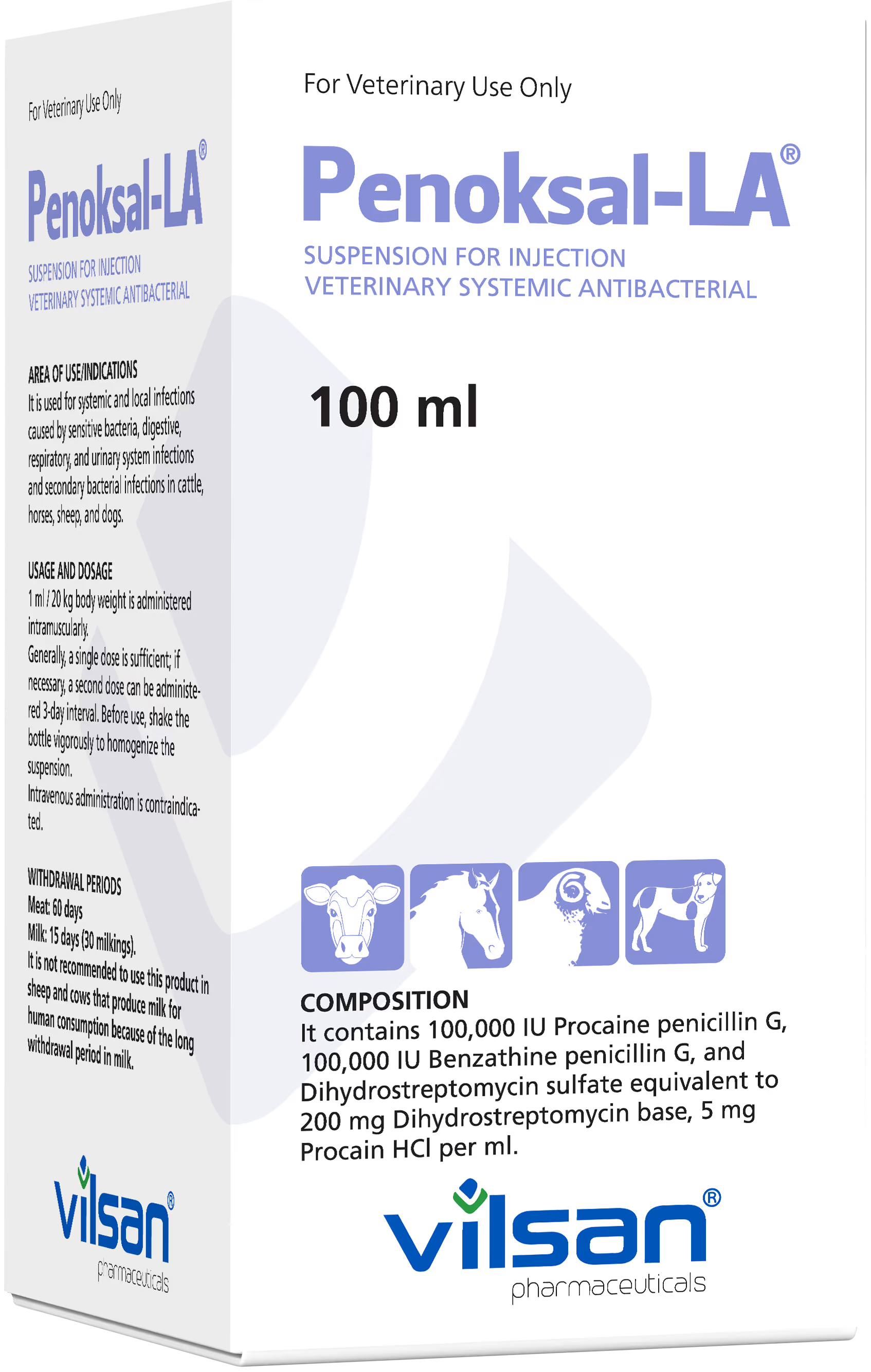
It is a white, ready-to-use, sterile suspension that becomes white when it is shaken, containing 100,000 IU Procaine penicillin G, 100,000 IU Benzathine penicillin G, and Dihydrostreptomycin sulfate equivalent to 200 mg Dihydrostreptomycin base, 5 mg Procain HCl per ml.
PHARMACOLOGICAL PROPERTIES
Penoksal-LA Suspension for Injection is a broad-spectrum, long-acting formulation effective against many gram-positive and gram-negative bacteria sensitive to the combination of penicillin and dihydrostreptomycin. The combined benzathine and procaine penicillin G primarily disrupt the cell wall synthesis of sensitive bacteria, especially during their replication phase, causing bacterial death. This action also facilitates the entry of streptomycin into the bacteria at higher concentrations. Consequently, dihydrostreptomycin, which penetrates bacteria at higher concentrations, exerts its effect by inhibiting protein synthesis. This combined and mutually reinforcing synergistic effect exhibits both bacteriostatic and bactericidal properties even at very low doses. Since penicillin is effective against gram-positive bacteria and dihydrostreptomycin against gram-negative bacteria, the spectrum of activity is broadened through synergy.
The synergistic effect resulting from the penicillin-dihydrostreptomycin combination covers a spectrum effective against both gram-positive and gram-negative bacteria. In vitro studies have demonstrated efficacy against the following bacteria: Corynebacterium pyogenes, Klebsiella pneumoniae, Listeria spp., Pasteurella haemolytica, Pasteurella multocida, Staphylococcus spp., Streptococcus spp., Peptostreptococcus spp., Erysipelothrix insidiosa, Clostridium spp., Escherichia coli, Proteus spp., Moraxella spp., Actinobacillus lignieresi, Haemophilus spp., and Salmonella spp.
Because of its depot effect, the drug is gradually absorbed from the injection site and is found in the bloodstream partially free and partially protein-bound (penicillin 80-90%, dihydrostreptomycin about 30%). It distributes into the kidneys, liver, lungs, skin and soft tissues, mucosa, serosa, and connective tissues. It is eliminated mostly unchanged via the kidneys (80-90%), with smaller amounts excreted in bile, milk, and sweat.
AREA OF USE/INDICATIONS
It is used for systemic and local infections caused by sensitive bacteria, digestive, respiratory, and urinary system infections and secondary bacterial infections in cattle, horses, sheep, and dogs
USAGE AND DOSAGE
1 ml / 20 kg body weight is administered intramuscularly.
Cattle-Horse (400 kg body weight) 20 ml
Calf-Heifer (200 kg body weight) 10 ml
Calf-Foal (100 kg body weight) 5 ml
Sheep (40 kg body weight) 2 ml
Dog (10 kg body weight) 0.5 ml
Generally, a single dose is sufficient; if necessary, a second dose can be administered 3-day interval.
Before use, shake the bottle vigorously to homogenize the suspension.
Intravenous administration is contraindicated.
Aseptic and antiseptic procedures must be followed during use.
Repeated injections at the same site should be avoided, especially in horses.
CONTRAINDICATIONS
Animals that are hypersensitive to penicillin, cephalosporins, and dihydrostreptomycin, as well as those with severe renal functional insufficiency, should not be treated with this product. It should not be administered intravenously.
Use during pregnancy: Because of potential neurotoxic, nephrotoxic, and ototoxic effects of dihydrostreptomycin on the fetus, it should not be used in pregnant animals.
ADVERSE EFFECTS
In sensitive animals, allergic and anaphylactic reactions such as urticaria, skin lesions, nausea, vomiting, difficulty breathing, pulmonary and laryngeal edema, vasomotor center paralysis, coma, and even death may occur. Especially in animals with impaired kidney function, dose-dependent high plasma concentrations of streptomycin can cause neurotoxic, nephrotoxic, and ototoxic effects. In cases of kidney failure, the dosage should be reduced to an adequate level.
DRUG INTERACTIONS
Calcium, sodium, potassium, and dextrose solutions, acids and alkalis, chlorothiazide, phenobarbital, phenytoin sodium, vitamin C, and B-complex vitamins show physical and chemical incompatibility; tetracyclines, ampicillin, cloxacillin, methicillin, carbenicillin, sulfadiazine, and nitrofurantoin exhibit antagonistic interactions. Due to the potential toxic effects of dihydrostreptomycin, it should not be used concurrently with other drugs known to be nephrotoxic, ototoxic, and neurotoxic and/or that may enhance these effects of dihydrostreptomycin (such as other aminoglycosides, furosemide, sulfonamides, tetracyclines, anesthetics, cephalosporins, etc.). Additionally, especially at high doses, it should be kept in mind that the use of penicillin-streptomycin combinations in animals under general anesthesia and/or muscle relaxants may increase neuromuscular blockade effects and could lead to fatalities.
SYMPTOMS OF OVERDOSE, PRECAUTIONS AND ANTIDOTE
If deafness that occurs from using doses or durations beyond the recommended limits becomes permanent, it cannot be treated. In case of hypersensitivity-related side effects, the medication should be discontinued immediately, and treatment should be initiated according to the clinical signs presented, using cardiac and respiratory stimulants, antihistamines, corticosteroids, and adrenaline.
WITHDRAWAL PERIODS
Meat: 60 days
Milk: 15 days (30 milkings)
It is not recommended to use this product in sheep and cows that produce milk for human consumption because of the long withdrawal period in milk.
GENERAL WARNINGS
Consult a veterinarian before use and if any unexpected reaction occurs.
Keep out of reach of children.
PRECAUTIONS TO BE TAKEN BY THE ADMINISTRATOR AND WARNINGS FOR VETERINARY SURGEON
Avoid to contact with the product and wash your hands after use. People known to be sensitive to penicillin and cephalosporins should not come into contact with the drug in any way. If sensitive people are exposed to the drug through the mouth, skin, or inhalation and experience symptoms such as swelling of the face, eyes, or lips, or difficulty breathing, urgent medical attention is required. In this case, the drug and label should be taken to the doctor.
STORAGE CONDITIONS AND SHELF LIFE
It should be stored in a refrigerator at 2 – 8 ºC, protected from light.
Shelf life is 2 years. It should be consumed in 28 days after first opening.
DISPOSAL AFTER USE AND WARNINGS FOR NON-TARGET SPECIES
As with other penicillins, it should not be used in small herbivores such as hamsters, rabbits, and guinea pigs, nor in waterfowl such as geese and ducks. Cats are much more sensitive to streptomycin compared to other species. Therefore, preparations containing streptomycin should not be used in cats.
COMMERCIAL PRESENTATION FORM
50 ml, 100 ml and 250 ml colorless type II flacons in a cardboard box.
PLACE AND CONDITIONS OF SALE
Sold with a veterinarian's prescription in pharmacies, veterinarian offices, polyclinics and animal hospitals (VSP).
APPROVAL DATE OF LEAFLET: 11.03.2021
MARKETING AUTHORIZATION DATE AND NO: 13.03.2001-010/0932
MARKETING AUTHORIZATION HOLDER
VİLSAN Veteriner İlaçları Tic. ve San. A.Ş.
Balıkhisar Mah. Balıkhisar Köy İçi Küme Evleri No:765A Akyurt/Ankara-Türkiye
MANUFACTURER COMPANY
VİLSAN Veteriner İlaçları Tic. ve San. A.Ş.
Balıkhisar Mah. Balıkhisar Köy İçi Küme Evleri No:765A Akyurt/Ankara-Türkiye
Made in Turkiye