| - | - | - |
|---|---|---|
| Product Group | : | Antibacterials |
| Pharmaceutical Form | : | Solution for Injection |
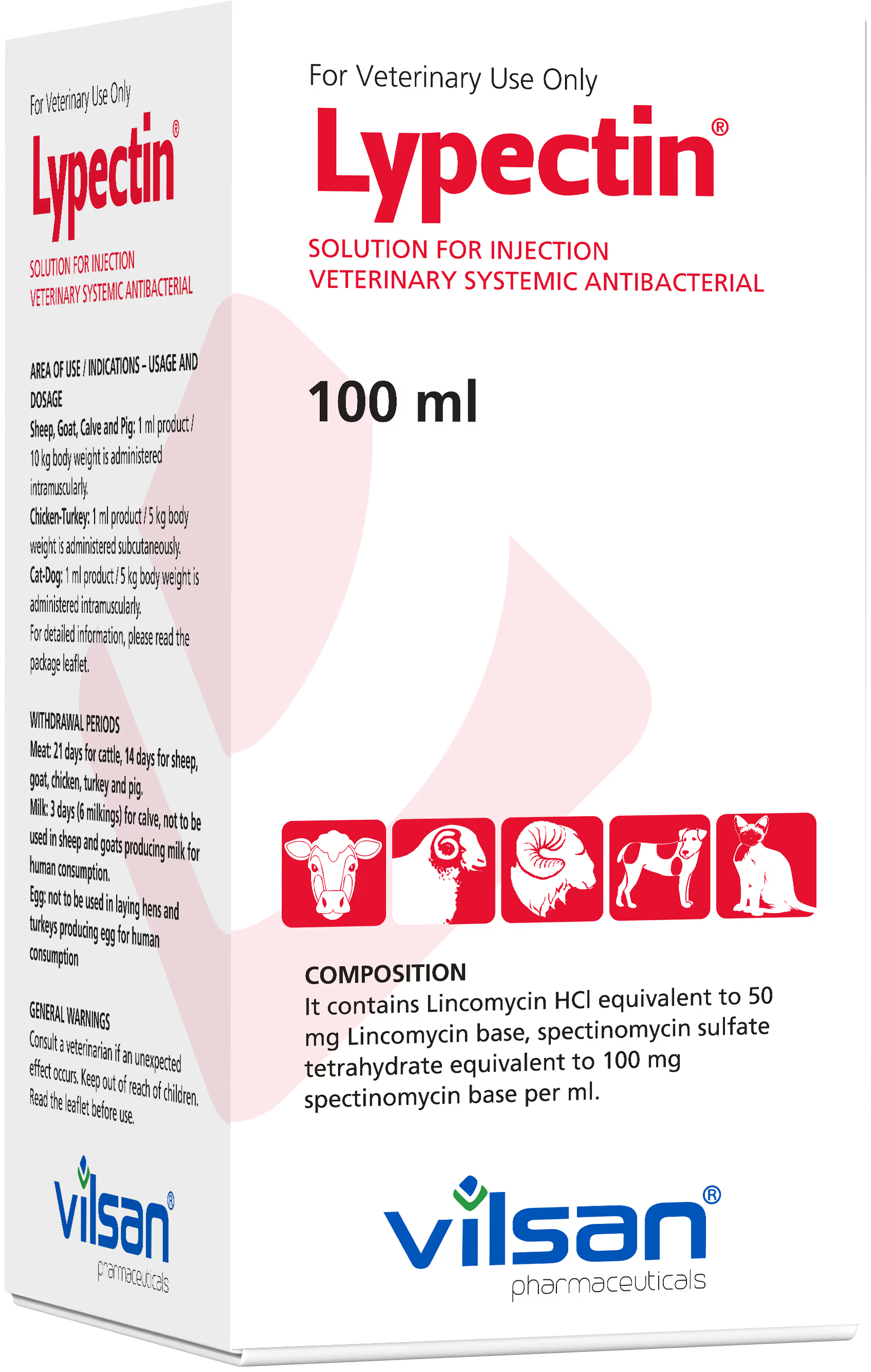
| Active Ingredient | : | Lincomycin HCl and Spectinomycin Sulfate |
| Target Animal | : | Calf, Sheep, Goat, Chicken, Turkey, Cat, Dog |
| Package Form | : | 20 ml, 50 ml and 100 ml colorless glass vials |
COMPOSITION
It is a colorless or light yellow colored clear solution containing 50 mg lincomycin base, 100 mg spectinomycin base per ml.
PHARMACOLOGICAL PROPERTIES
Pharmacodynamic Properties
Lincomycin is a broad-spectrum antibiotic from the lincosamide group, effective against Gram-positive and Gram-negative bacteria as well as mycoplasmas. Spectinomycin, on the other hand, is an aminocyclitol group antibiotic that is effective against Gram-negative bacteria, especially Enterobacteriaceae, and mycoplasmas.
Lincomycin is a lincosamide antibiotic produced by Streptomyces lincolnensis. It is effective against Gram-positive (aerobic and anaerobic), Gram-negative anaerobic bacteria, and mycoplasmas. It binds to the 50S subunit of bacterial ribosomes and inhibits protein synthesis. Depending on sensitivity and concentration, it exhibits either bactericidal or bacteriostatic effects.
Spectinomycin is an aminocyclitol antibiotic produced by Streptomyces spectabilis. It is effective against mycoplasmas and some Gram-negative and Gram-positive bacteria. It binds to the 30S subunit of bacterial ribosomes and inhibits protein synthesis. It is bacteriostatic. Resistance to spectinomycin may lead to resistance to aminoglycosides, erythromycin, and tylosin.
Pharmacokinetic Properties
Lincomycin is well distributed throughout the body and is significantly metabolized. It is primarily eliminated by the liver and also excreted in the milk of lactating animals. Spectinomycin similarly shows good distribution and is mainly excreted unchanged, primarily through the kidneys.
AREA OF USE/INDICATIONS
It is used in the treatment of respiratory, digestive, urinary tract infections, soft tissue infections, and arthritis caused by susceptible strains of the following microorganisms in calve, sheep, goat, chicken, turkey, cat and dog:
Actinobacillus spp.
Pasteurella spp.
Escherichia coli
Salmonella spp.
Campylobacter spp.
Bacteroides spp.
Clostridium spp.
Fusobacterium spp.
Actinomyces spp.
Staphylococcus spp.
Streptococcus spp.
Mycoplasma spp.
USAGE AND DOSAGE
Calve:
5 mg lincomycin and 10 mg spectinomycin / kg body weight (1 ml product / 10 kg body weight) is administered intramuscularly, twice on the first day and once daily thereafter for 3–5 days.
Sheep-goat:
5 mg lincomycin and 10 mg spectinomycin / kg body weight (1 ml product / 10 kg body weight) is administered intramuscularly, once daily for 3–5 days.
Chicken and turkey:
10 mg lincomycin and 20 mg spectinomycin / kg body weight (1 ml product / 5 kg body weight) is administered intramuscularly, once daily for 3 days.
Cat-dog:
10 mg lincomycin and 20 mg spectinomycin / kg body weight (1 ml product / 5 kg body weight) is administered intramuscularly, 1–2 times daily, for 3–7 days depending on clinical response.
Animals should be weighed as accurately as possible to ensure correct dosage.
SPECIAL CLINICAL INFORMATION AND SPECIAL WARNINGS FOR TARGET SPECIES
Use of this product in lactating animals may cause gastrointestinal side effects in suckling offspring.
This product should be used based on the results of susceptibility testing of bacteria isolated from animals. If that is not possible, treatment should be based on regional epidemiological data related to the target bacteria. Use with caution in animals with known allergic reactions. Do not exceed the recommended dose in goats and sheep during late pregnancy and early lactation.
Use of this product outside the conditions specified in the product information may lead to the development of resistant bacteria and potentially reduce the efficacy of macrolides due to possible cross-resistance.
Use during pregnancy and lactation:
The safety of this product in pregnant and breeding animals has not been established. Therefore, it should be used according to the veterinarian's benefit/risk assessment.
ADVERSE EFFECTS
May cause local discomfort at the injection site. Rarely, temporary diarrhea, soft feces, skin redness, and restlessness may occur. Loss of appetite may occur in rare cases. Individual animals may experience allergic reactions and neuromuscular blockade. If gastrointestinal side effects start immediately after administration or if diarrhea worsens, treatment should be discontinued.
In the event of an allergic reaction, treatment should be stopped and symptomatic treatment initiated. In cases of anaphylactic shock, intravenous epinephrine and glucocorticoids should be used; for skin reactions, antihistamines and/or glucocorticoids are recommended.
In individual cases, agranulocytosis, leukopenia, thrombocytopenia, increased serum AST activity affecting cardiac conduction, and hypotension have been observed.
DRUG INTERACTIONS
Do not use in combination with macrolides. Co-administration with anesthetics or other agents causing neuromuscular blockade may lead to neuromuscular blockade. Lincomycin is incompatible in vitro with penicillins and kanamycin.
There is complete cross-resistance with clindamycin.
SYMPTOMS OF OVERDOSE, PRECAUTIONS AND ANTIDOTE
Do not exceed the recommended dose.
WITHDRAWAL PERIODS
Meat: 21 days for cattle, 14 days for sheep, goat, chicken and turkey.
Not to be used in laying hens and turkeys producing eggs for human consumption, and in sheep and goats producing milk for human consumption.
CONTRAINDICATIONS
Do not use in animals known to be hypersensitive to the components.
Do not use in horses, rabbits, guinea pigs, hamsters, or chinchillas, as it may cause serious gastrointestinal disorders.
Do not use in ruminating cattle. Do not use in neonates due to potential toxic effects.
Do not use in animals with liver dysfunction. In cases of impaired kidney function, the dose should be reduced and intervals extended.
GENERAL WARNINGS
Consult a veterinarian if unexpected effects occur. Keep out of reach of children.
PRECAUTIONS TO BE TAKEN BY THE ADMINISTRATOR AND WARNINGS FOR VETERINARY SURGEON
Exposure to lincomycin and spectinomycin by injection, inhalation, ingestion, or skin contact may cause hypersensitivity reactions. Allergic reactions can be severe. Individuals known to be sensitive to these substances should avoid contact. Precautions should be taken to avoid skin and eye contact. In case of accidental contact, rinse the affected area with plenty of water.
Appropriate precautions should be taken to minimize exposure risk.
If symptoms such as redness appear after exposure, consult a doctor with the product label.
Swelling of the eye sockets, face, and lips, or difficulty breathing are serious symptoms requiring immediate medical attention.
Precautions should be taken to avoid accidental self-injection. In case of accidental injection, seek medical attention immediately.
Wash hands after use.
STORAGE CONDITIONS AND SHELF LIFE
It should be stored in the original package below 25°C, protected from light. Do not freeze or refrigerate. Shelf life is 2 years.
DISPOSAL AFTER USE AND WARNINGS FOR NON-TARGET SPECIES
Unused or leftover product must be disposed of according to local regulations.
COMMERCIAL PRESENTATION FORM
20 ml, 50 ml and 100 ml colorless glass vials, in cardboard boxes.
PLACE AND CONDITIONS OF SALE
Sold with a veterinarian's prescription in pharmacies, veterinarian offices, polyclinics and animal hospitals. (VHR)
APPROVAL DATE OF LEAFLET: 09.03.2026
MARKETING AUTHORIZATION DATE AND NO: 20.06.2006-016/0029
MARKETING AUTHORIZATION HOLDER
VİLSAN Veteriner İlaçları Tic. ve San. A.Ş.
Balıkhisar Mah. Balıkhisar Köy İçi Küme Evleri No:765A Akyurt/Ankara-Türkiye
MANUFACTURER COMPANY
VİLSAN Veteriner İlaçları Tic. ve San. A.Ş.
Balıkhisar Mah. Balıkhisar Köy İçi Küme Evleri No:765A Akyurt/Ankara-Türkiye
Made in Turkiye