| - | - | - |
|---|---|---|
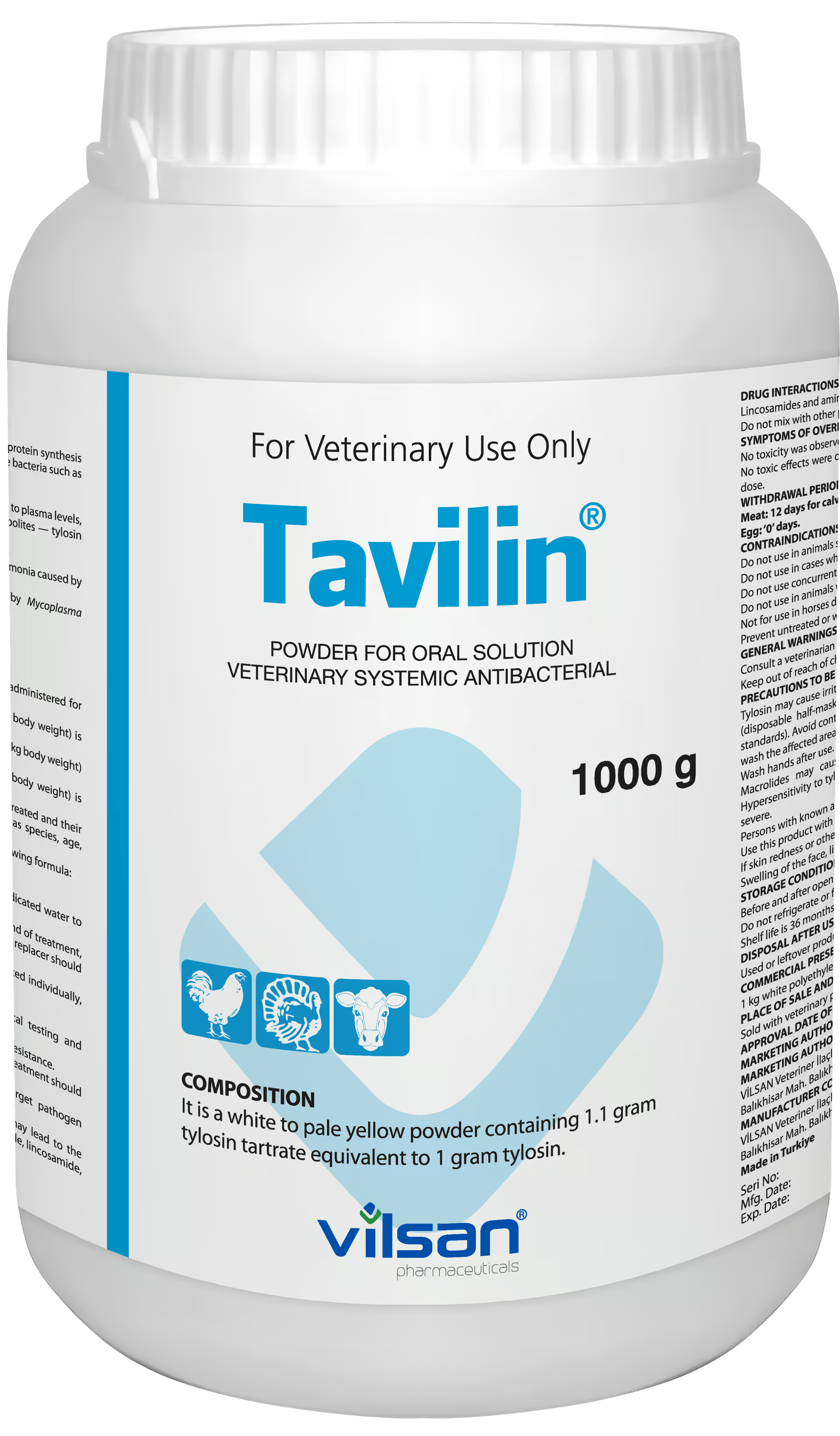
| Product Group | : | Antibacterials |
| Pharmaceutical Form | : | Powder for Oral Solution |
| Active Ingredient | : | Tylosin tartrate |
| Target Animal | : | Calf, Chicken, Turkey |
| Package Form | : | In 1 kg polyethylene jars |
COMPOSITION
It is a white to pale yellow powder containing 1.1 gram tylosin tartrate equivalent to 1 gram tylosin.
PHARMACOLOGICAL PROPERTIES
Pharmacodynamic Properties
Tylosin is a macrolide group antibiotic produced by Streptomyces fradiae. It exerts its effect by inhibiting protein synthesis in susceptible microorganisms. Activity spectrum includes Gram-positive bacteria, certain Gram-negative bacteria such as Pasteurella and Mycoplasma species.
Pharmacokinetic Properties
Peak plasma concentrations are reached within 1–2 hours after administration in most species. Compared to plasma levels, significantly higher concentrations are achieved in tissues. Tylosin is extensively metabolized. Its metabolites — tylosin (factor A), relomycin (factor D), and dihydrodesmycosin — are excreted via feces.
AREA OF USE/INDICATIONS
Calves: Treatment and metaphylaxis (prevention of disease spread within already affected herds) of pneumonia caused by Mycoplasma spp.
Chickens: Treatment and metaphylaxis of CRD (chronic respiratory disease) infections caused by Mycoplasma gallisepticum and Mycoplasma synoviae.
Treatment and prevention of necrotic enteritis caused by Clostridium perfringens in diagnosed flocks.
Turkeys: For the treatment and metaphylaxis of infectious sinusitis caused by Mycoplasma gallisepticum.
USAGE AND DOSAGE
Administered orally with drinking water. In calves, it can also be given with milk or milk replacer.
Calves: 20–40 mg tylosin / kg body weight/day (equivalent to 22–44 mg product / kg body weight) is administered for 7–14 days. The daily dose should be divided into two administrations (morning and evening).
Turkeys: Administer 75–100 mg tylosin / kg body weight/day (equivalent to 82.5–110 mg product / kg body weight) is adminitered for 3–5 days.
Chickens (CRD treatment): 75–100 mg tylosin / kg body weight/day (equivalent to 82.5–110 mg product / kg body weight) is administered for 3–5 days.
Chickens (necrotic enteritis): 20 mg tylosin / kg body weight/day (equivalent to 22 mg product / kg body weight) is administered for 3 days.
When preparing medicated water, milk, or milk replacer, the average body weight of the animals to be treated and their actual consumption must be carefully measured. Consumption may vary depending on factors such as species, age, management conditions, and health status.
The amount of product to be added per liter of water/milk/milk replacer can be calculated using the following formula:
…… mg product/kg body weight/day × Average body weight (kg) of animals to be treated
÷ Average daily consumption of water/milk/milk replacer (L) = …… mg product/L
No other water should be offered during the treatment period. Ensure animals have easy access to medicated water to achieve adequate intake.
If there is no response to treatment within 3 days, the clinical approach should be re-evaluated. At the end of treatment, the water system must be thoroughly cleaned to avoid subtherapeutic dosing. Medicated water/milk/milk replacer should be refreshed every 24 hours.
Animals showing severe signs of infection (e.g., significantly reduced feed/water intake) should be treated individually, preferably by injection.
SPECIAL CLINICAL INFORMATION AND SPECIAL WARNINGS FOR TARGET SPECIES
Because bacterial susceptibility to tylosin may vary over time and between regions, bacteriological testing and susceptibility assessment are recommended.
Avoid underdosing or insufficient duration of treatment, as these may contribute to the development of resistance.
National and regional antimicrobial use policies must be considered when using this product. Preferably, treatment should be based on susceptibility testing of bacteria isolated from the animals.
If this is not possible, treatment should rely on local (regional) epidemiological data regarding target pathogen susceptibility.
Improper use of this product not in accordance with the Summary of Product Characteristics (SPC) may lead to the development of resistant bacteria and may reduce the effectiveness of other antibiotics from the macrolide, lincosamide, and streptogramin B classes due to potential cross-resistance.
ADVERSE EFFECTS
No specific adverse effects have been identified in the target species.
DRUG INTERACTIONS
Lincosamides and aminoglycosides inhibit the activity of tylosin.
Do not mix with other products.
SYMPTOMS OF OVERDOSE, PRECAUTIONS AND ANTIDOTE
No toxicity was observed in rats following oral administration at a dose of 1 g/kg.
No toxic effects were observed in chickens, turkeys, and calves when administered up to three times the recommended dose.
WITHDRAWAL PERIODS
Meat: 12 days for calves, 2 days and 1 day for turkeys and chickens.
Egg: ‘0’ days.
CONTRAINDICATIONS
Do not use in animals sensitive to tylosin or other macrolides.
Do not use in cases where resistance to tylosin or cross-resistance to other macrolides is known.
Do not use concurrently with vaccines sensitive to tylosin, or within one week prior to vaccination.
Do not use in animals with hepatic insufficiency.
Not for use in horses due to the risk of severe inflammation in the cecum.
Prevent untreated or wild animals from accessing increased or leftover medicated water.
GENERAL WARNINGS
Consult a veterinarian before use and if any unexpected reactions occur.
Keep out of reach of children.
PRECAUTIONS TO BE TAKEN BY THE ADMINISTRATOR AND WARNINGS FOR VETERINARY SURGEON
Tylosin may cause irritation. Avoid inhalation of the product. Use protective gloves and masks compliant with standards (disposable half-mask respirators conforming to EN149 or respirators with filters conforming to EN143 and EN140 standards). Avoid contact with the product and medicated water. In case of contact with medicated water or the product, wash the affected area thoroughly with soap and water. In case of eye contact, rinse immediately with clean running water. Wash hands after use. Do not eat, drink, or smoke while handling the product.
Macrolides may cause hypersensitivity reactions following injection, inhalation, oral exposure, or skin contact. Hypersensitivity to tylosin may cause cross-reactivity with other macrolides (and vice versa). Allergic reactions are rarely severe.
Persons with known allergies or advised to avoid such products should not handle this product.
Use this product with great care, taking all necessary precautions to prevent exposure.
If skin redness or other signs of irritation occur after exposure, seek medical advice and show this warning to your doctor. Swelling of the face, lips, or eyes, or difficulty breathing are serious symptoms requiring immediate medical attention.
STORAGE CONDITIONS AND SHELF LIFE
Before and after opening, it should be stored in the original packaging, below 25°C, protected from sunlight, in a dry place. Do not refrigerate or freeze.
Shelf Life is 36 months.
DISPOSAL AFTER USE AND WARNINGS FOR NON-TARGET SPECIES
Used or leftover product must be disposed of in accordance with applicable regulations.
COMMERCIAL PRESENTATION FORM
1 kg white polyethylene jars without boxes.
PLACE OF SALE AND CONDITIONS
Sold with veterinary prescription; available at pharmacies, veterinary clinics, polyclinics, and animal hospitals (VSP).
APPROVAL DATE OF LEAFET: 21.02.2022
MARKETING AUTHORIZATION DATE AND NO: 08.02.1999 - 009/0845
MARKETING AUTHORIZATION HOLDER
VİLSAN Veteriner İlaçları Tic. ve San. A.Ş.
Balıkhisar Mah. Balıkhisar Köy İçi Küme Evleri No:765A Akyurt/Ankara-Türkiye
MANUFACTURER COMPANY
VİLSAN Veteriner İlaçları Tic. ve San. A.Ş.
Balıkhisar Mah. Balıkhisar Köy İçi Küme Evleri No:765A Akyurt/Ankara-Türkiye
Made in Turkiye