| - | - | - |
|---|---|---|
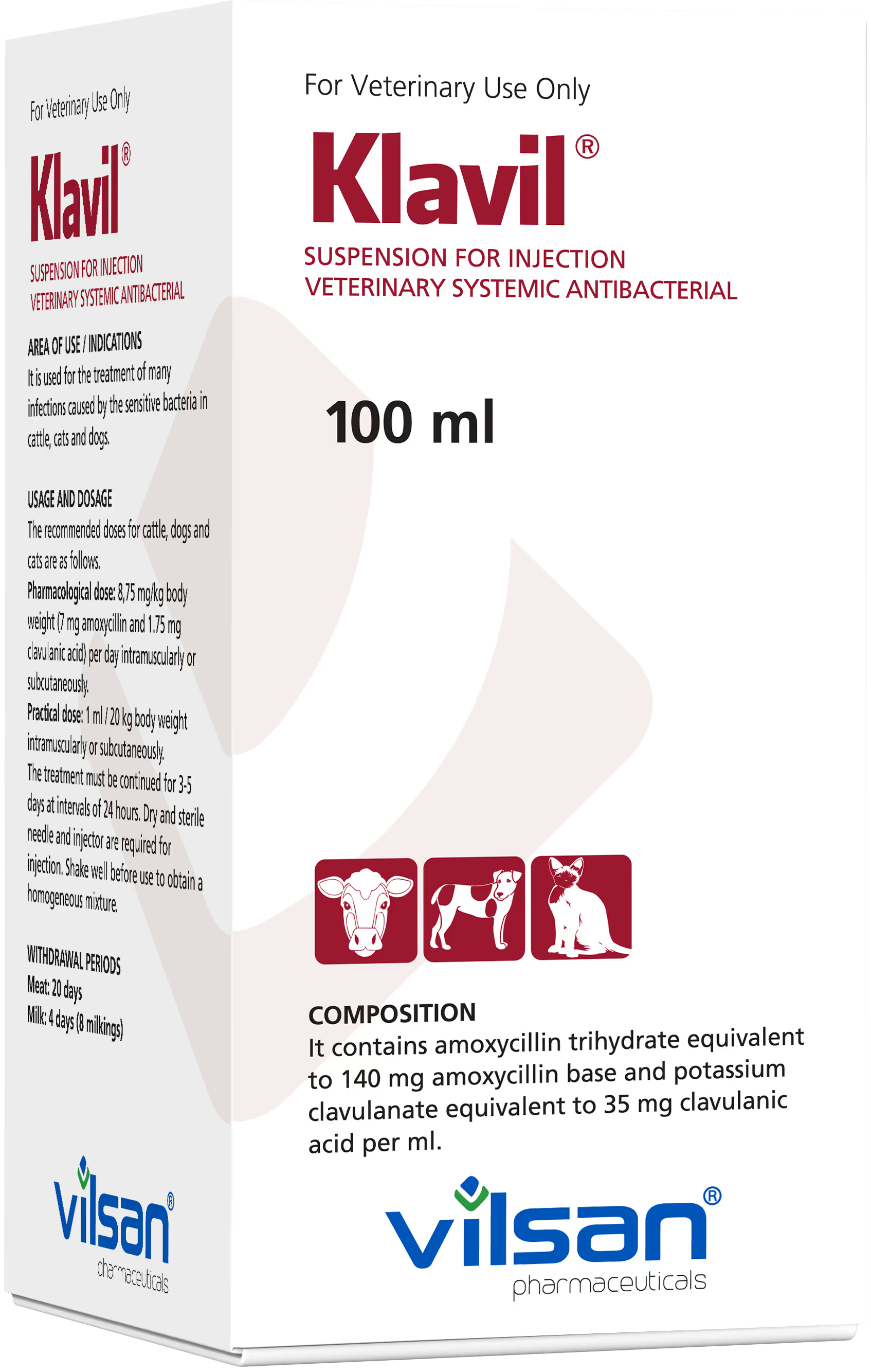
| Product Group | : | Antibacterials |
| Pharmaceutical Form | : | Suspension for Injection |
| Active Ingredient | : | Amoxicillin trihydrate and Clavulanic acid |
| Target Animal | : | Cattle, Cat, Dog |
| Package Form | : | 50 ml and 100 ml colorless glass bottles |
COMPOSITION
It is a sterile suspension with a color ranging from cream to light brown, containing 140 mg amoxicillin equivalent to amoxicillin trihydrate base, 35 mg potassium clavulanate equivalent to clavulanic acid, 10 mg benzyl alcohol as a preservative per ml.
PHARMACOLOGICAL PROPERTIES
Pharmacodynamic properties
Amoxicillin is a bactericidal, semi-synthetic antibiotic belonging to the aminopenicillin group with a broad antibacterial spectrum. β-lactam antibiotics exert their effect by binding to proteins involved in bacterial cell wall synthesis, leading to the ultimate lysis of the cell.
In Gram-positive bacteria, β-lactam freely passes through the peptidoglycan layer in the liquid phase to reach its target site on the cytoplasmic membrane. In Gram-negative bacteria, there is a hydrophobic barrier outside the peptidoglycan layer. Broad-spectrum β-lactam antibiotics have the ability to pass through this barrier via small pores in their structure.
Mechanism of action: The antimicrobial effect mechanism primarily involves selectively and irreversibly inhibiting many enzymes such as transpeptidase, endopeptidase, and carboxypeptidase, which biochemically regulate bacterial cell wall synthesis. By inhibiting cell wall synthesis, it blocks peptidoglycan chain synthesis, thereby disrupting cell wall formation. In susceptible bacteria, especially during cell division, disruption of cell wall synthesis leads to bacterial lysis.
There are three main resistance mechanisms: production of β-lactamase enzymes, impermeability of the cell wall due to alteration of small pores, and alteration of the amino acid sequence at the cytoplasmic membrane interface where the cell wall is formed.
Bacterial resistance to amoxicillin is primarily due to β-lactamases that hydrolyze the β-lactam ring of antimicrobials. Bacterial β-lactamases can be encoded either on the bacterial chromosome or on plasmids. These β-lactamases are extracellular in Gram-positive bacteria (e.g., Staphylococcus aureus), whereas in Gram-negative bacteria, they are found in the periplasmic space. Gram-positive bacteria can produce large amounts of β-lactamase. These enzymes are encoded on plasmids, which can be transferred to other bacteria. Gram-negative bacteria produce different types of β-lactamases encoded on chromosomes or plasmids, located in the periplasmic space. There is full cross-resistance between amoxicillin and other penicillins, especially other aminopenicillins.
Clavulanic Acid
In the absence of specific inhibitory enzymes for β-lactamase activity, β-lactamases either form complexes with the antibiotic or cause degradation of the β-lactam ring. In both cases, antibacterial activity is lost.
Clavulanic acid contains a β-lactam ring structurally recognized as a penicillin type by β-lactamases. The enzyme/clavulanate interaction is irreversible and results in the depletion of enzyme molecules.
Pharmacokinetic Properties
After daily intramuscular administration of the product at the recommended dose for five consecutive days, the following parameters were observed:
For amoxicillin:
Cmax 1.69 µg/ml, Tmax 2.67 hours, AUC 30.59 µg·ml⁻¹·hour, t½ 15.22 hours
For clavulanic acid:
Cmax: 0.94 µg/ml, Tmax 1.3 hours, AUC 3.123 µg·ml⁻¹·hour, t½ 1.71 hours.
After subcutaneous administration of the maximum recommended dose to dogs, the following parameters were observed for amoxicillin:
Cmax 8.66 µg/ml, Tmax 1.78 hours, AUC 50.98 µg·ml⁻¹·hour
AREA OF USE/INDICATIONS
This product is bactericidal against clinically important bacteria found in pets. It has a broad spectrum, including bacteria that have developed resistance to amoxicillin by producing beta-lactamase, as shown in in-vitro studies:
Gram-positive bacteria:
Actinomyces bovis
Bacillus anthracis
Clostridia
Corynebacteria
Peptostreptococcus species
Staphylococci
Streptococci
Gram-negative bacteria:
Actinobacillus lignierisi
Actinobacillus pleuropneumoniae
Bacteroides
Bordetella bronchiseptica
Campylobacter species
Escherichia coli
Fusobacterium necrophorum
Haemophilus species
Klebsiellae
Moraxella species
Pasteurellae
Proteus species
Salmonellae
Clinically indicated for the treatment of the following infections:
Cattle:
Respiratory system infections, soft tissue infections (such as umbilical cord infections, abscesses, etc.), metritis.
Cats and Dogs:
Respiratory tract infections, urinary tract infections, skin and soft tissue infections (including abscesses, pyodermas, anal gland infections, and gingivitis).
USAGE AND DOSAGE
Intramuscular (IM) for cattle; subcutaneous (SC) or intramuscular (IM) for dogs and cats.
Recommended Dosage:
8.75 mg/kg body weight daily for 3–5 consecutive days (which corresponds to 7 mg amoxicillin and 1.75 mg clavulanic acid per kg body weight), or 1 ml per 20 kg body weight.
Shake well before use. Use a dry and sterile syringe and needle.
Disinfect the stopper before each dose.
In cattle, the maximum volume administered per injection site should not exceed 10 ml.
Do not use the product if any color change has occurred.
After injection, massage the injection site.
SPECIAL CLINICAL INFORMATION AND SPECIAL WARNINGS FOR TARGET SPECIES
Clavulanic acid is sensitive to moisture. Therefore, completely dry syringes and needles must be used, and contact of the remaining product with water should be avoided. Contact with water causes brown discoloration in the product, which results in reduced potency. Shake well before use.
In case of allergic reactions, treatment should be discontinued.
Incorrect use of this product may increase the incidence of bacteria resistant to amoxicillin/clavulanic acid or other beta-lactams.
In cases of renal or hepatic insufficiency, the dosage regimen should be carefully evaluated.
Official national and regional antimicrobial policies should be considered when using this product.
Use this product based on susceptibility test results of bacteria obtained from the animals. If this is not possible, treatment should be based on regional epidemiological sensitivity data for the target bacteria.
Use during pregnancy and lactation:
Studies conducted on laboratory animals have shown no evidence of teratogenic effects of the product. The safety of the product has not been evaluated in pregnant cows, dogs, cats, or lactating animals.
The decision to use the drug should be made by the veterinarian after a benefit/risk assessment.
ADVERSE EFFECTS
Following administration, diarrhea and sweating may rarely occur. Use of the product may sometimes cause pain or irritation at the injection site and/or local tissue reaction. Allergic reactions (such as skin reactions, anaphylaxis) may occur. The use of the product may occasionally result in pain and/or local tissue reactions at the injection site. These reactions are usually moderate and manifest as swelling and/or induration. After administration of the recommended dose, these may persist for up to 2 weeks in the thigh and leg muscles, and up to 4 days in the neck muscles.
Pain may rarely occur during administration. Application of this product may cause pain, local reactions, and itching at the injection site.
If an allergic reaction occurs, treatment should be discontinued and symptomatic treatment should be applied.
DRUG INTERACTIONS
Amoxicillin has a bactericidal effect, which may be neutralized when used concurrently with compounds that have bacteriostatic activity (e.g., macrolides, sulfonamides, tetracyclines). Cross-reactivity with other penicillins is possible. Penicillins may enhance the effect of aminoglycosides.
Do not mix with other veterinary medicinal products.
SYMPTOMS OF OVERDOSE, PRECAUTIONS AND ANTIDOTE
Potentiated penicillins have low toxicity and are well tolerated when administered parenterally. Other than occasional injection site reactions that may occur even at the recommended dose, no additional adverse effects are expected in the event of accidental overdose.
In cattle, the product was well tolerated for up to 5 days at twice the recommended dose. In studies conducted at both normal and twice the normal dose, transient and dose-dependent muscle damage at the injection site was observed, characterized by increased creatine kinase and aspartate aminotransferase levels. These injection site reactions were dose-dependent and, even at double the recommended dose, completely resolved within 2 weeks when administered in the leg or thigh muscles, and within 4 days when administered in the neck.
No other clinically significant abnormalities were observed.
In dogs, the product was well tolerated for up to 6 days at three times the recommended dose, although injection site reactions may occur 2 weeks after administration at three times the recommended dose.
WITHDRAWAL PERIODS
Meat: 42 days
Milk: 80 hours (7 milkings)
CONTRAINDICATIONS
Do not use in rabbits, guinea pigs, hamsters, or gerbils. Use with caution in other small herbivores.
Do not use in animals known to be hypersensitive to penicillins or other beta-lactams.
Do not use in animals with severe renal dysfunction accompanied by anuria or oliguria.
Do not use via routes other than those recommended.
GENERAL WARNINGS
In case of unexpected adverse effects, consult a veterinarian.
Keep out of reach of children.
PRECAUTIONS TO BE TAKEN BY THE ADMINISTRATOR AND WARNINGS FOR VETERINARY SURGEON
Exposure to penicillins or cephalosporins via ingestion, inhalation, skin contact, or injection may cause hypersensitivity reactions. Hypersensitivity to penicillins can lead to hypersensitivity to cephalosporins (and vice versa). Reactions to these substances can rarely be very severe. If you are sensitive to these substances, avoid contact with the product. Use the product by taking all necessary precautions to avoid exposure. If symptoms such as redness occur on the skin after exposure, seek medical help and show your doctor the product label/package insert. Swelling of the face, lips, or eyes, or difficulty breathing are very serious symptoms and require immediate medical attention. Wash your hands after use.
In case of accidental contact, rinse the affected area immediately with plenty of water.
STORAGE CONDITIONS AND SHELF LIFE
Store in the original package, protected from light, below 25°C. Do not refrigerate or freeze.
Shelf life is 24 months.
DISPOSAL AFTER USE AND WARNINGS FOR NON-TARGET SPECIES
Any unused product or waste materials should be disposed of in accordance with local regulations.
COMMERCIAL PRESENTATION FORM
50 ml and 100 ml colorless glass vials with box.
PLACE AND CONDITIONS OF SALE
Sold in pharmacies and veterinary clinics with a veterinary prescription. (VPR)
APPROVAL DATE OF LEAFLET: 29.08.2023
MARKETING AUTHORIZATION DATE AND NO: 09.11.2006-017/0012
NAME AND ADDRESS OF MARKETING AUTHORIZATION HOLDER
VİLSAN Veteriner İlaçları Tic. ve San. A.Ş.
Balıkhisar Mah. Balıkhisar Köy içi Küme Evleri No: 765A Akyurt/Ankara – Türkiye
MANUFACTURER COMPANY
VİLSAN Veteriner İlaçları Tic. ve San. A.Ş.
Balıkhisar Mah. Balıkhisar Köy içi Küme Evleri No: 765A Akyurt/Ankara – Türkiye
Made in Turkiye