| - | - | - |
|---|---|---|
| Product Group | : | Antibacterials |
| Pharmaceutical Form | : | Suspension for Injection |
| Active Ingredient | : | Procaine penicillin G, Dihydrostreptomycin sulfate |
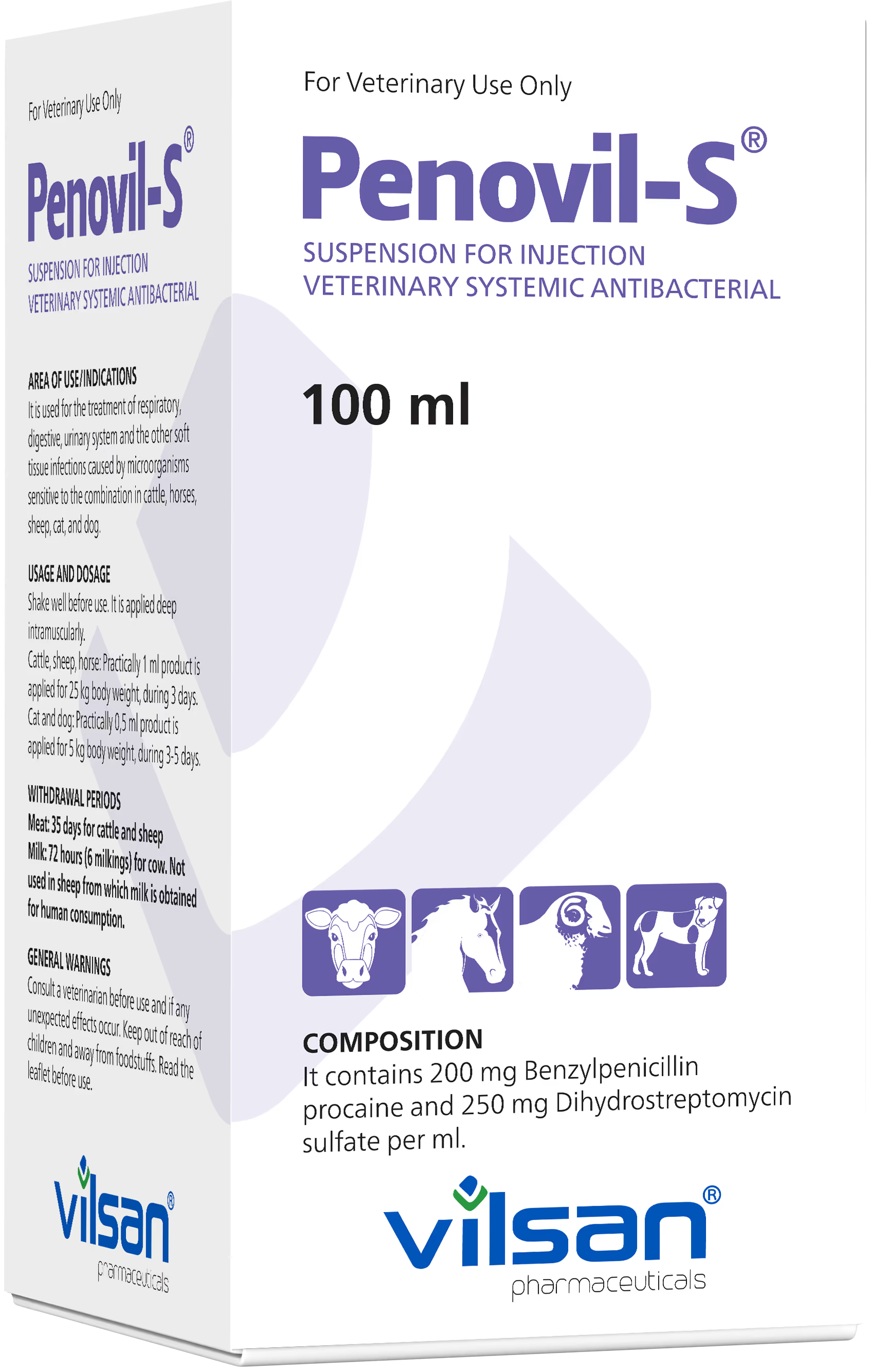
| Target Animal | : | Cattle, Sheep, Horse, Dog, Cat |
| Package Form | : | 20 ml, 50 ml, 100 ml Amber Colored Glass Flacons |
COMPOSITION
It is a white or cream colored suspension when it is shaked, containing 200 mg Benzylpenicillin procaine and 250 mg Dihydrostreptomycin sulfate per ml.
PHARMACOLOGICAL PROPERTIES
Pharmacodynamic Properties
Penicillin G is a beta-lactam antibiotic and, like other penicillins, contains thiazolidine and beta-lactam rings. beta-lactams act by inhibiting the development of the bacterial cell wall in susceptible Gram-positive bacteria by inhibiting peptidoglycan synthesis at the final stage.
Inhibit the enzyme transpeptidase. It shows bactericidal effect and causes lysis of developing cells.
Dihydrostreptomycin is an aminoglycoside group antibiotic effective against Gram negative bacteria. It acts by binding to receptors on the 30S subunit of bacterial ribosomes. As a result, the codes on mRNA are misread and bacteriostasis develops.
Aminoglycosides show synergistic effect with betalactams.
Pharmacokinetics Properties
After injection, procaine penicillin is rapidly absorbed from the injection site, with levels achieved approximately 2 hours after administration (1-2 μg/ml in horses, sheep, goat and pigs, 0.5 μg/ml in cattle).
The elimination half-life of penicillin is approximately 2 hours in sheep, goat and pigs, 5 hours in cattle and 11 hours in horses.
Dihydrostreoptomycin is absorbed at similar rates, with maximum plasma levels of approximately 23 μg/ml in pigs, cattle and cattle and 15 μg/ml in horses. The elimination half-life is approximately 2 hours in cattle, sheep, goat, pigs and 4 hours in horses.
AREA OF USE/INDICATIONS
It is used for the treatment of respiratory, digestive, urinary system and the other soft tissue infections caused by below microorganisms sensitive to the combination in cattle, horses, sheep, goat, cat, and dog;
Arcanobacterium pyogenes,
Erysipelothrix rhusiopathiae,
Klebsiella pneumoniae,
Listeria spp.,
Mannheimia haemolytica,
Pasteurella multocida,
Staphylococcus spp., (non-penicillinase-producing),
Streptococcus spp.,
Salmonella spp.
USAGE AND DOSAGE
Shake well before use. It is applied deep intramuscularly.
Cattle, sheep, goat, horse: 8 mg/kg body weight benzylpenicillin procaine and 10 mg/kg body weight dihydrostreptomycin sulfate; practically 1 ml product is applied for 25 kg body weight, during 3 days. Maximum 15 ml for horse, 6 ml for cattle, 3 ml for sheep and goat should applied an injection site.
Cat and dog: 8-20 mg/kg body weight benzylpenicillin procaine and 10-25 mg/kg body weight dihydrostreptomycin sulfate; practically 0,5 ml product is applied for 5 kg body weight, during 3-5 days.
SPECIAL CLINICAL INFORMATION AND SPECIAL WARNINGS FOR TARGET SPECIES
Use in the animals with kidney disease or functional impairment, carefully. Do not exceed the recommended dosage. Do not use in rabbits and small rodents. Do not exceed the recommended dosage. Aminoglycosides have a narrower margin of safety than penicillins. Use this product according to bacterial susceptibility results obtained from animals. If this is not possible, treatment should be based on regional epidemiologic data. Use of this product other than as directed may result in the development of betalactam- or aminoglycoside-resistant bacteria and reduced efficacy against other bacteria due to cross-resistance.
Use during pregnancy and lactation: There are no studies on the safe use of the product in pregnant animals. Use in pregnant animals is subject to veterinary benefit/risk assessment
ADVERSE EFFECTS
Transient local reaction may be observed after intramuscular injection in horses. Rarely allergic reactions may occur. These reactions may range from local swelling to anaphylaxis and death. Hearing and balance disorders and impaired renal function may occur, especially in long-term use. Cramps and difficulty in breathing may occur due to the neuromuscular blocking effect of dihydrostreptomycin. In case of side effects, it is recommended to discontinue treatment and to treat according to the side effect observed. Neuromuscular blocking effects of aminoglycosides can be partially eliminated with calcium and neostigmine administration.
DRUG INTERACTIONS
It should not be used in combination with antibiotics such as other aminoglycosides and tetracyclines. It should not be used with pentobarbital and other inhalation anesthetics because of the risk of vascular depression. It should not be used in combination with other products that increase neuromuscular blockade (muscle relaxants) and diuretics because of the increased risk of ototoxicity. Not used in combination with heparin, calcium gluconate, riboflavin and triamcinolone. It is not used in combination with sulfonamides as it reduces the effect of procaine. This product should not be mixed with other products.
SYMPTOMS OF OVERDOSE, PRECAUTIONS AND ANTIDOTE
Excess doses of dihydrostreptomycin may cause muscle weakness and respiratory arrest due to neuromuscular blockade and other effects. Procaine poisoning can cause convulsions, hypotension, and psychosis. Horses are the most susceptible species to the side effects of procaine. Other nervous system findings such as muscle weakness, incoordination, imbalance, excitement, and convulsions have been observed in other animals.
WITHDRAWAL PERIODS
Meat: 35 days for cattle, sheep and goat
Milk: 72 hours (6 milkings) for cow. Not used in sheep and goat from which milk is obtained for human consumption.
CONTRAINDICATIONS
Do not use in animals sensitive to betalactams.
GENERAL WARNINGS
Consult a veterinarian before use and if any unexpected effects occur. Keep out of reach of children and away from foodstuffs.
PRECAUTIONS TO BE TAKEN BY THE ADMINISTRATOR AND WARNINGS FOR VETERINARY SURGEON
Take precautions to avoid accidental self-injection. In such a case, seek medical advice immediately. Penicillin and cephalosporins can cause hypersensitivity (allergy) reactions after skin contact, ingestion by mouth, inhalation or injection. There is a cross-reaction between penicillins and cephalosporins. Allergic reactions can rarely be very serious.
1-Do not use the product if you are sensitive or have been told not to come into contact with such products.
2-Take necessary precautions to prevent exposure during the application of the product.
3-If you see symptoms such as skin rash after exposure, consult a doctor immediately with the label and package insert. Symptoms such as swelling of the face, eyes or lips or difficulty breathing are much more serious and require immediate medical attention. Wash your hands after use.
STORAGE CONDITIONS AND SHELF LIFE
Before and after opening, the product should be stored in refrigerator, protected from light, between 2 – 8 °C. Shelf life is 2 years. It should be used within 28 days after opening.
DISPOSAL AFTER USE AND WARNINGS FOR NON-TARGET SPECIES
Used or remaining product should be disposed of according to the relevant regulations.
COMMERCIAL PRESENTATION FORM
20 ml, 50 ml, 100 ml and 250 ml Type II amber-colored glass vials with cardboard box.
PLACE AND CONDITIONS OF SALE
It is sold in pharmacies and veterinary clinics with a veterinarian's prescription. (VSP)
APPROVAL DATE OF LEAFLET: 19.02.2025
MARKETING AUTHORIZATION DATE AND NO: 21.08.2000 – 010/0901
MARKETING AUTHORIZATION HOLDER
VİLSAN Veteriner İlaçları Tic. ve San. A.Ş.
Balıkhisar Mah. Balıkhisar Köy İçi Küme Evleri No:765A Akyurt/Ankara-Türkiye
MANUFACTURER COMPANY
VİLSAN Veteriner İlaçları Tic. ve San. A.Ş.
Balıkhisar Mah. Balıkhisar Köy İçi Küme Evleri No:765A Akyurt/Ankara-Türkiye
Made in Türkiye