| - | - | - |
|---|---|---|
| Product Group | : | Antibacterials |
| Pharmaceutical Form | : | Powder for Oral Solution |
| Active Ingredient | : | Erythromycin thiocyanate |
| Target Animal | : | Chicken, Turkey |
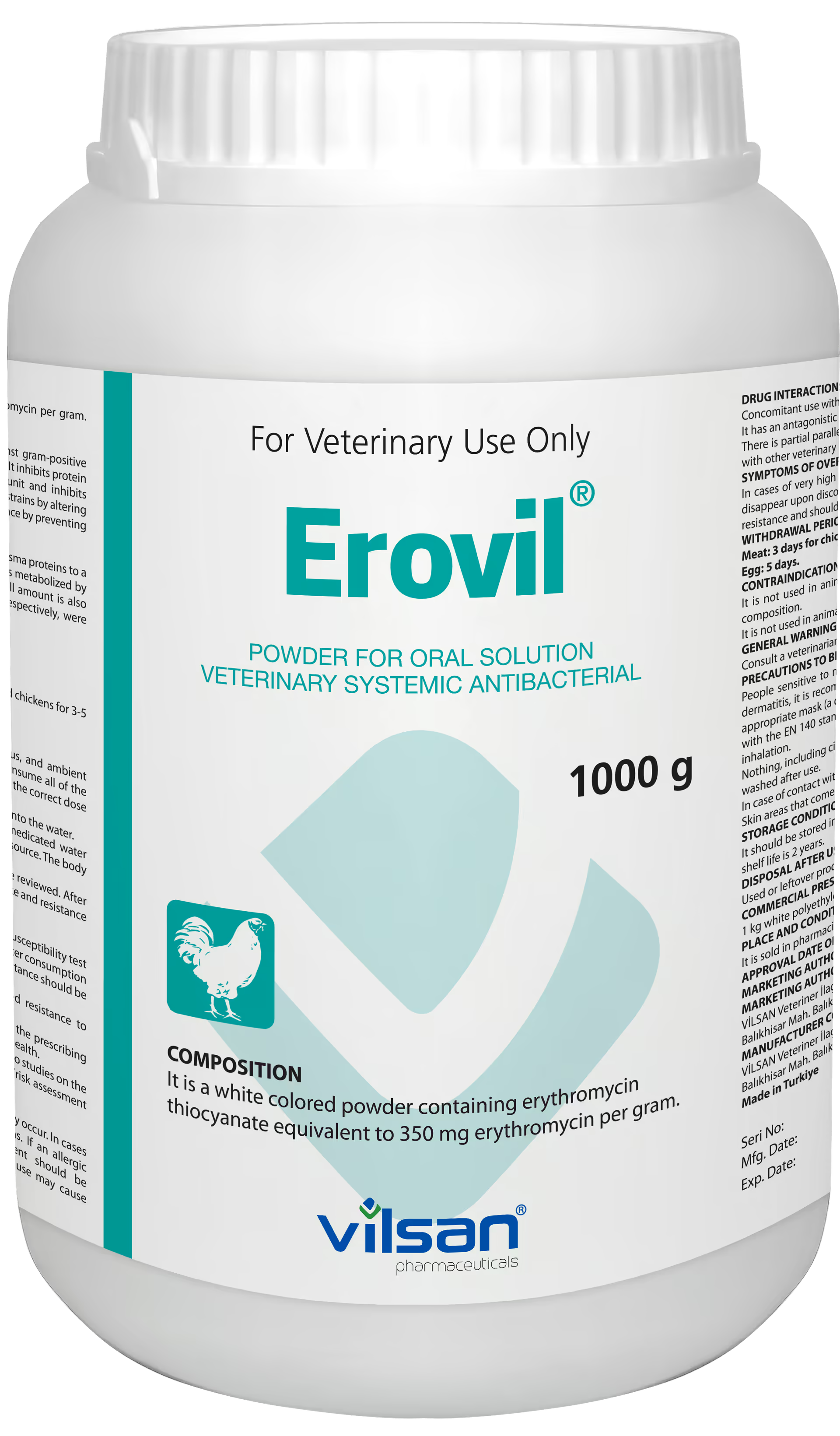
| Package Form | : | 1 kg white polyethylene jars |
COMPOSITION
It is a white colored powder containing erythromycin thiocyanate equivalent to 350 mg erythromycin per gram.
PHARMACOLOGICAL PROPERTIES
Pharmacodynamic Properties
Erythromycin is an antibiotic belonging to the macrolide group and is primarily effective against gram-positive bacteria. Although it has a bacteriostatic effect, it exhibits a bactericidal effect at therapeutic doses. It inhibits protein synthesis in bacteria by acting on ribosomes. Like other macrolides, it binds to the 50S subunit and inhibits translocation during the elongation phase. Resistance to erythromycin may develop in susceptible strains by altering the substance's ability to bind to ribosomes. Gram-negative bacteria are thought to develop resistance by preventing erythromycin from passing through the cell wall.
Pharmacokinetics Properties
Bioavailability in poultry is over 90% when administered orally. Like other macrolides, it binds to plasma proteins to a limited extent (20-30%) and distributes evenly and rapidly to all tissues, particularly the lungs. It is metabolized by the liver, and both the absorbed and unabsorbed portions are excreted in the feces. A very small amount is also excreted in the urine. At a dose of 30 mg/kg, Cmax and Tmax values of 5.0 μg/ml and 1.7 hours, respectively, were obtained in poultry. The half-life is 3-5 hours.
Acute toxicity is very low. The oral LD50 value in rats, mice, and hamsters is 3000 mg/kg.
AREA OF USE/INDICATIONS
It is used for the treatment of infections caused by Mycoplasma species in chickens and turkeys.
USAGE AND DOSAGE
It is used at a dose of 20-40 mg/kg erythromycin base/day mixed into drinking water for turkeys and chickens for 3-5 days
Practically, 58-115 grams should be used for every 1000 kg of body weight per day.
The product amount should be calculated correctly to avoid overdosing.
Since the amount of medicated water may vary depending on factors such as age, health status, and ambient temperature that affect the animals' water intake, it should be adjusted so that the animals can consume all of the medication. Therefore, the concentration of the medicated water may need to be adjusted to ensure the correct dose is provided. The use of appropriately calibrated weighing equipment is recommended.
Medicated water should be prepared fresh every day. The medication should be completely mixed into the water.
There should be sufficient water sources so that the animals can consume equal amounts of medicated water whenever possible. During treatment, animals should not be allowed to drink water from any other source. The body weight of the animals should be calculated as accurately as possible to avoid underdosing.
If no significant improvement is seen within 3 days after starting treatment, the diagnosis should be reviewed. After treatment, the irrigation system should be thoroughly washed to prevent sub-therapeutic dose intake and resistance development.
SPECIAL CLINICAL INFORMATION AND SPECIAL WARNINGS FOR TARGET SPECIES
This product should be used in accordance with national/regional antimicrobial usage policies and susceptibility test results. It should not be mixed with solid feed. The dosage of the drug may vary due to changes in water consumption depending on the status of the infection. Repeated and prolonged use should be avoided, and importance should be given to good management practices and stress prevention in the facility.
Use of the product in a manner different from the instructions for use may lead to increased resistance to erythromycin or other antibiotics due to cross-resistance.
Due to limited information on the environmental effects of erythromycin, it is recommended that the prescribing veterinarian prescribe the product and direct its use in a manner that will not affect environmental health.
Use during laying: Studies in laboratory animals have not shown any teratogenic effects. There are no studies on the safe use of the product in laying animals of the target species. Therefore, the veterinarian's benefit/risk assessment should be considered when using the product.
ADVERSE EFFECTS
Mild to moderate gastrointestinal disturbances may occasionally occur. Hepatotoxic effects may rarely occur. In cases of impaired renal function, reversible hearing loss may occur due to high plasma concentrations. If an allergic reaction occurs, treatment should be discontinued immediately and symptomatic treatment should be administered. In rats, high and repeated doses may cause spermatogenesis to stop. Long-term use may cause intestinal dysbiosis and the development of resistant strains.
DRUG INTERACTIONS
Concomitant use with lincosamides is not useful due to the same target site in bacteria.
It has an antagonistic effect with erythromycin, beta-lactams, gentamicin, and trimethoprim.
There is partial parallel resistance between lincosamides and erythromycin. It should not be used in combination with other veterinary medicinal products.
SYMPTOMS OF OVERDOSE, PRECAUTIONS AND ANTIDOTE
In cases of very high doses, symptoms generally related to the gastrointestinal system are observed. Symptoms disappear upon discontinuation of treatment. Early discontinuation of treatment may lead to the development of resistance and should only be done on the advice of a veterinarian.
WITHDRAWAL PERIODS
Meat: 3 days for chicken, 6 days for turkey.
Egg: 5 days.
CONTRAINDICATIONS
It is not used in animals known to be sensitive to erythromycin or other macrolides or any ingredients in the composition. It is not used in animals with liver failure.
GENERAL WARNINGS
Consult a veterinarian before use and if any unexpected effects occur. Keep out of reach of children.
PRECAUTIONS TO BE TAKEN BY THE ADMINISTRATOR AND WARNINGS FOR VETERINARY SURGEON
People sensitive to macrolides should avoid contact with the product. To avoid sensitivity reactions or contact dermatitis, it is recommended to wear gloves/clothing that will prevent contact with the product. In addition, an appropriate mask (a disposable half-mask respirator compliant with the EN 149 standard or a respirator compliant with the EN 140 standard equipped with a filter compliant with the EN 143 standard) should be used to prevent inhalation.
Nothing, including cigarettes, should be eaten or drunk while preparing or applying the product. Hands should be washed after use.
In case of contact with eyes, rinse thoroughly with water and seek immediate medical attention if irritation persists. Skin areas that come into contact with the product should be washed with water.
STORAGE CONDITIONS AND SHELF LIFE
It should be stored in the original packages, below 25°C, away from sunlight, without refrigeration or freezing. The shelf life is 2 years.
DISPOSAL AFTER USE AND WARNINGS FOR NON-TARGET SPECIES
Used or leftover product must be disposed of according to the relevant legislation.
COMMERCIAL PRESENTATION FORM
1 kg white polyethylene jars without a box.
PLACE AND CONDITIONS OF SALE
It is sold in pharmacies and veterinary clinics with a veterinarian's prescription. (VSP)
APPROVAL DATE OF LEAFLET: 21.12.2022
MARKETING AUTHORIZATION DATE AND NO: 24.08.2009 – 021/0077
MARKETING AUTHORIZATION HOLDER
VİLSAN Veteriner İlaçları Tic.ve San. A.Ş.
Balıkhisar Mah. Balıkhisar Köy İçi Küme Evleri No:765A Akyurt/Ankara–Türkiye
MANUFACTURER COMPANY
VİLSAN Veteriner İlaçları Tic.ve San. A.Ş.
Balıkhisar Mah. Balıkhisar Köy İçi Küme Evleri No:765A Akyurt/Ankara–Türkiye
Made in Turkiye